
The Public Manager Magazine Article
Member Benefit
Managing Cross-Sector Collaboration
Mon Dec 15 2014

Content
Cross-sector collaboration (CSC) is becoming a more familiar fixture on the governance landscape. Alliances involving government, business, and nonprofit organizations are now addressing issues that were once viewed as the prerogative of government.
Cross-sector collaboration (CSC) is becoming a more familiar fixture on the governance landscape. Alliances involving government, business, and nonprofit organizations are now addressing issues that were once viewed as the prerogative of government.
Content
Local healthcare services, foster care and adoptions, safe drinking water and water treatment, homeless shelters, wildfire response and recovery, reduced greenhouse gas emissions, building and improving roads, park maintenance, expanding seaports and building airports: All these and other public goods and services are now delivered through some form of cross-sector collaboration.
Local healthcare services, foster care and adoptions, safe drinking water and water treatment, homeless shelters, wildfire response and recovery, reduced greenhouse gas emissions, building and improving roads, park maintenance, expanding seaports and building airports: All these and other public goods and services are now delivered through some form of cross-sector collaboration.
Why Cross-Sector Collaboration?
Content
Public managers engage business and nonprofits in CSCs for several reasons. Many governments are facing a budget crunch at the same time that the cost of and demand for public services is on the rise. CSC can be one way to bring additional resources to communities and areas of need.
Public managers engage business and nonprofits in CSCs for several reasons. Many governments are facing a budget crunch at the same time that the cost of and demand for public services is on the rise. CSC can be one way to bring additional resources to communities and areas of need.
Content
In addition, many of today's complex problems—childhood obesity, for example—require responses from multiple and interconnected sectors and perspectives. CSC brings together different actors, each with unique expertise, experiences, and vantage points to find solutions to these problems.
In addition, many of today's complex problems—childhood obesity, for example—require responses from multiple and interconnected sectors and perspectives. CSC brings together different actors, each with unique expertise, experiences, and vantage points to find solutions to these problems.
Content
Typically, businesses and nonprofits have greater flexibility than government agencies and are positioned to move more quickly and take advantage of emerging opportunities. As a result, CSC allows governments to offer public services that may be more responsive and adaptive to citizens' needs.
Typically, businesses and nonprofits have greater flexibility than government agencies and are positioned to move more quickly and take advantage of emerging opportunities. As a result, CSC allows governments to offer public services that may be more responsive and adaptive to citizens' needs.
Content
For these reasons and others, the practice of CSC is growing and expanding. Public managers are right to raise questions and concerns about their efficacy, but CSCs are growing in popularity and they are here to stay as a tool of governance.
For these reasons and others, the practice of CSC is growing and expanding. Public managers are right to raise questions and concerns about their efficacy, but CSCs are growing in popularity and they are here to stay as a tool of governance.
Different CSC Approaches
Content
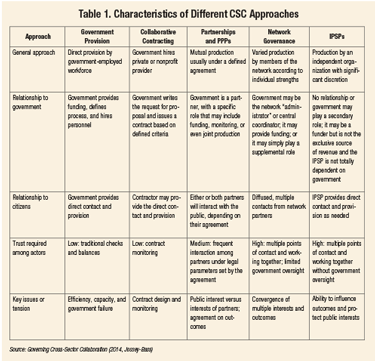
CSCs come in all shapes and sizes and have adapted to the specific conditions found in local communities or state and federal governments. Emerging from the diverse practices are four basic CSC approaches. Each one offers a different set of relationships, expectations, and governance issues that must be managed by public managers.
CSCs come in all shapes and sizes and have adapted to the specific conditions found in local communities or state and federal governments. Emerging from the diverse practices are four basic CSC approaches. Each one offers a different set of relationships, expectations, and governance issues that must be managed by public managers.
Content
Collaborative contracting. These "complex" modes of contracting generally adhere to one or more of the following characteristics:
Collaborative contracting. These "complex" modes of contracting generally adhere to one or more of the following characteristics:
Content
They involve "incomplete" specifications of expectations because the involved parties modify their requirements over the course of the exchange.
They involve "incomplete" specifications of expectations because the involved parties modify their requirements over the course of the exchange.
Content
They are "relational"—they involve aspects of governance that stretch beyond the formal or written terms of agreement.
They are "relational"—they involve aspects of governance that stretch beyond the formal or written terms of agreement.
Content
They are generally long term in nature and involve frequent interactions of the parties.
They are generally long term in nature and involve frequent interactions of the parties.
Content
Partnerships and public-private partnerships (PPPs). Governments collaborate with businesses or nonprofits in three typical ways:
Partnerships and public-private partnerships (PPPs). Governments collaborate with businesses or nonprofits in three typical ways:
Content
short-term, one-to-one partnerships for a specific purpose or goal, such as private and public formation of a downtown business district or commercial development, or a partnership between government and a local community organization to fund and equip a local park
short-term, one-to-one partnerships for a specific purpose or goal, such as private and public formation of a downtown business district or commercial development, or a partnership between government and a local community organization to fund and equip a local park
Content
intermediate-term partnerships involving government and nonprofit providers, such as a state department of human services or a local shelter for the homeless
intermediate-term partnerships involving government and nonprofit providers, such as a state department of human services or a local shelter for the homeless
Content
long-term partnerships involving the creation or renewal of major infrastructure projects (often termed P3s in North America), which include private financing and operations and maintenance of infrastructure systems and facilities.
long-term partnerships involving the creation or renewal of major infrastructure projects (often termed P3s in North America), which include private financing and operations and maintenance of infrastructure systems and facilities.
Content
Network governance. Collaborative arrangements that involve a broad range of non-governmental stakeholders working interdependently with government. Networks typically organize themselves in three different ways:
Network governance. Collaborative arrangements that involve a broad range of non-governmental stakeholders working interdependently with government. Networks typically organize themselves in three different ways:
Content
shared or self-governed, where network members are collectively involved in their own governance
shared or self-governed, where network members are collectively involved in their own governance
Content
lead organization, where one entity coordinates the network's operations
lead organization, where one entity coordinates the network's operations
Content
network administrative organization, where a designated entity (with designated staff and responsibilities) supports and governs the network's activities.
network administrative organization, where a designated entity (with designated staff and responsibilities) supports and governs the network's activities.
Content
Independent public-services providers (IPSPs). This emergent form of collaboration is distinctive by not being directed by government officials. Typically funded by foundations, fees, grants, or gifts, it can set its own agenda and select approaches to delivering public services:
Independent public-services providers (IPSPs). This emergent form of collaboration is distinctive by not being directed by government officials. Typically funded by foundations, fees, grants, or gifts, it can set its own agenda and select approaches to delivering public services:
Content
PSPs are typically organized as diverse networks, engaging business, nonprofits, and governments to work collaboratively, and undertaking innovations that improve current practices.
PSPs are typically organized as diverse networks, engaging business, nonprofits, and governments to work collaboratively, and undertaking innovations that improve current practices.
Content
IPSPs operate outside the typical bureaucratic and political constraints public managers face every day.
IPSPs operate outside the typical bureaucratic and political constraints public managers face every day.
Content
The four different CSC forms offer public managers choices on which approach is best suited to promote the interests and goals of the government program being implemented.
The four different CSC forms offer public managers choices on which approach is best suited to promote the interests and goals of the government program being implemented.
Relationships and Expectations
Content
Each CSC is distinguished by the type of relationship the government has with its collaborators as well as expectations for government's role in the CSC.
Each CSC is distinguished by the type of relationship the government has with its collaborators as well as expectations for government's role in the CSC.
Content
Collaborative contracting entails the greatest levels of direction and control provided by the government in the CSC.
Collaborative contracting entails the greatest levels of direction and control provided by the government in the CSC.
Content
PPPs and partnerships allow greater discretion to private and nonprofit partners, and public managers rely more heavily on their partners for guidance on the best approaches to delivering public services.
PPPs and partnerships allow greater discretion to private and nonprofit partners, and public managers rely more heavily on their partners for guidance on the best approaches to delivering public services.
Content
Network governance involves even more independence by its members. Governments may play a relatively small role in the operations of networks, allowing members to operate and coordinate in a way that has proved to be effective. Governments may guide networks in goal setting and the framing of outcomes, but networks often operate and deliver services outside of day-to-day bureaucratic control or review.
Network governance involves even more independence by its members. Governments may play a relatively small role in the operations of networks, allowing members to operate and coordinate in a way that has proved to be effective. Governments may guide networks in goal setting and the framing of outcomes, but networks often operate and deliver services outside of day-to-day bureaucratic control or review.
Content
IPSPs are largely autonomous and set their own priorities and agendas. Government agencies may be invited to participate among the other private and nonprofit participants, but they do not select nor veto IPSP activities.
IPSPs are largely autonomous and set their own priorities and agendas. Government agencies may be invited to participate among the other private and nonprofit participants, but they do not select nor veto IPSP activities.
Advantages and Disadvantages
Content
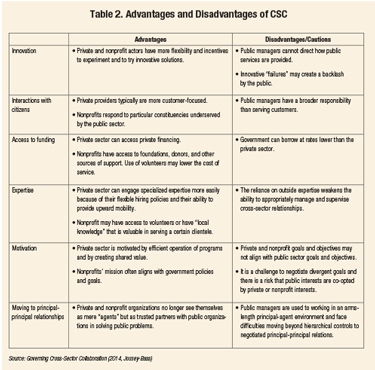
Public managers must choose the nature of their involvement in CSCs carefully. A misunderstanding of reasonable expectations for relationships and responsibilities within CSCs is the greatest threat to their success. When selecting the best type of CSC, public managers need to take account of numerous factors, including:
Public managers must choose the nature of their involvement in CSCs carefully. A misunderstanding of reasonable expectations for relationships and responsibilities within CSCs is the greatest threat to their success. When selecting the best type of CSC, public managers need to take account of numerous factors, including:
Content
nature of the public task or challenge
nature of the public task or challenge
Content
resource needs and capacity
resource needs and capacity
Content
identification and allocation of risk
identification and allocation of risk
Content
best value for the public's dollars
best value for the public's dollars
Content
measuring performance and ensuring accountability.
measuring performance and ensuring accountability.
Content
Experience suggests that some CSCs are formed with relative ease when interests, needs, timing, and expectations align, such as responses to natural disasters. Others, and particularly those that are engaging collaborators on more challenging issues—such as teenage homelessness and abuse—require a lot of work, patience, and perseverance to come together.
Experience suggests that some CSCs are formed with relative ease when interests, needs, timing, and expectations align, such as responses to natural disasters. Others, and particularly those that are engaging collaborators on more challenging issues—such as teenage homelessness and abuse—require a lot of work, patience, and perseverance to come together.
Content
Some CSCs may take several years to mature, learn from their experiences, and reinvent themselves, to find their full potential. Understanding the advantages and disadvantages to governing through CSC is essential for public managers.
Some CSCs may take several years to mature, learn from their experiences, and reinvent themselves, to find their full potential. Understanding the advantages and disadvantages to governing through CSC is essential for public managers.
Cross-Sector Collaboration and Democratic Accountability
Content
Successful CSCs operate in heterarchies, providing them greater discretion, flexibility, and even autonomy—it allows them to be creative, innovative, and adaptive. Citizens benefit by receiving better public services. Yet this same strength of CSC also raises legitimate concerns over democratic accountability.
Successful CSCs operate in heterarchies, providing them greater discretion, flexibility, and even autonomy—it allows them to be creative, innovative, and adaptive. Citizens benefit by receiving better public services. Yet this same strength of CSC also raises legitimate concerns over democratic accountability.
Content
To address these concerns, public managers should focus on four "pillars" of democratic accountability:
To address these concerns, public managers should focus on four "pillars" of democratic accountability:
Content
Agree on clear measures of outcomes.
Agree on clear measures of outcomes.
Content
Create public value.
Create public value.
Content
Promote a trusted partnership.
Promote a trusted partnership.
Content
Increase citizen awareness and engagement (creative uses of social media can help promote these actions in an integrated and highly effective way).
Increase citizen awareness and engagement (creative uses of social media can help promote these actions in an integrated and highly effective way).
Content
CSC offers novel approaches to governance that can result in dramatic improvements in the delivery of public services in a rapidly changing world. One thing that has not changed is the public manager's responsibility for ensuring that any CSC is undertaken in the public interest.
CSC offers novel approaches to governance that can result in dramatic improvements in the delivery of public services in a rapidly changing world. One thing that has not changed is the public manager's responsibility for ensuring that any CSC is undertaken in the public interest.
Content
Public managers can choose from four types of cross-sector collaboration. Here's a look into the tradeoffs of each type.
View Courses Recommended for You